In response to Alphone's question - "What is the London Eye?". I am posting some photographs, taken back in 2000, soon after the Eye came into service.
Tuesday, January 08, 2008
London Eye
Wednesday, January 02, 2008
Memorial day - 30
David Batchelor's popular festive lights display Festival Remix has returned to the Southbank Centre London for the Christmas, New Year season.
The works include neon-outlined concrete mixers, a waste skip full of lights and colourful recycled bottles.
Through his artwork David Batchelor explores the concept of colour as a unique phenomenon: how colour’s omnipresence in everyday experience transcends function and aesthetics to create its own symbolic orders. In 2008 his 'Found Monochromes' series will be included in 'Color Chart' at the Museum of Modern Art, New York – a major exhibition of post-war colour-based work.
Labels: David Batchelor, Royal Festival Hall
Monday, December 24, 2007
Ephemeral art
The photograph was posted on My Shared Images
It was a cold wet Monday afternoon in early November, London's South Bank was blessedly free of tourists. Passing by Festival Hall I saw two figures under the Queen Elizabeth Hall podium - this area is normally crowded with skateboarders, trick-cyclists and graffiti artists. One was spraying while the other watched.
I stopped to watch as he meticulously applied the final touches to his painting. I was struck by the time and effort invested in the work - particularly as the graffiti would not be seen by many, or last very long. A Tag painted on the wall lasts on average at most a few days, before it is covered by another tag, or the daub of some paint toting young yob. I was inquisitive to know - what was his motivation.
I went to speak to the artist, who turned out to be a German visiting London for the day. Why paint graffiti? Why not put his obvious talents to another form of painting?
The answer was simple - it's what I do.
But it will only last a few hours.
It doesn't matter, I know for a few hours my work will have appeared on a wall in London.
At the time I couldn't understand the motivation, but on reflection I realise a large section of performance art is ephemeral - music, ballet and drama. Appreciated by the audience at the time of the performance, then just a memory.
The next morning I walked past the wall and as anticipated the graffiti had been obliterated by another.
The photo on the right? Well that's what the same piece of wall looked like yesterday afternoon - but there's a good chance its already been painted over by more graffiti.
As I said in Friday's blog "Artists give a representation of perceived reality", so it is with graffiti - we live in a disposable world.
Wednesday, November 14, 2007
Memorial day - 23
The subject of Memorial day 16, published on 26th September, was Urban Nebula a work by Zaha Hadid installed on the Royal Festival Hall podium as part of this years London Design Festival.
Also installed in the Hall's square, adjacent to Belvedere Road, was Amanda Levete's 18 metre long curved wall composed of 300 Corian "Prototile leaves".
Asked if the work "Prototile" is a piece of public art, the Welsh architect, Levete was reported to reply "it's in an in-between territory where we're exploring a material and producing a non-functional subject."
Corian is the registered trademark of one of many building materials collectively known as solid surface. A thermosetting plastic composed of acrylic polymer and alumina trihydrate made by DuPont. The 300 pieces were vacuum-formed.
Labels: Corian, London Design Festival, Prototile, Royal Festival Hall
Wednesday, September 26, 2007
Memorial day - 16
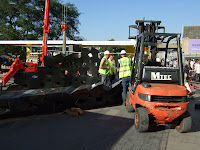
The majority of subjects of the Wednesday "Memorial Day" blogs have been in location for many years and are permanent installations. But today's work of public art was a temporary exhibit outside the Royal Festival Hall, as part of the London Design Festival.
The work is described as -
"Urban Nebula by Zaha Hadid is an in-between project, hovering between street furniture, sculpture and a furniture piece in its own right. Composed of 150 pre-cast concrete blocks, courtesy of concrete company Aggregate Industries. It stands 2.5 metres high.With its polished and fluid surface,
the piece explores sensuality in a material that doesn't often evoke that idea.
Charles Walker, of Hadid's office, who worked on the project says, 'Ben Evans was interested in Zaha working with concrete because of its plastic potential. When you look at the history of concrete, there's always been experimentation with its plastic form, but at a monolithic level'"
Zaha Hadid was the first woman to win the Pritzker Prize for Architecture in its 26 year history. She has defined a radically new approach to architecture by creating buildings, such as the Rosenthal Centre for Contemporary Art in Cincinnati, with multiple perspective points and fragmented geometry to evoke the chaos of modern life.
Born in Baghdad, Iraq, she received a degree in mathematics from the American University of Beirut before moving to London to study at the Architectural Association School of Architecture. After graduating she worked with her former teacher, Dutch architect Rem Kolhaas at the Office for Metropolitan Architecture, becoming a partner in 1977.